The Starbridge Model
The Starbridge model is built around one person: a returned missionary of The Church of Jesus Christ of Latter-day Saints, living in the community where the academy will open. The Foundation builds the system once — curriculum, platform, playbook, and brand — and provides it to every founder at no cost. The founder does the part no system can: shows up every day, runs the academy, and builds on trust they already have.
The Starbridge Foundation (nonprofit)
- Owns and stewards the brand, curriculum, the Starbridge Learning Platform, and standards
- Provides startup guidance, technology standards, and operational frameworks
- Sets minimum quality, ethics, and student-protection standards
- Raises philanthropic capital so founders can fund startup costs — a loan, not a stake
- Does not operate day-to-day academies
Local Founders (independent owner-operators)
- License the Starbridge brand and model
- Get full access to the Starbridge Learning Platform at no cost
- Secure a location, hire local teachers, run daily operations
- Keep 100% of the profit — no revenue share, no royalties
- Report transparently and uphold Starbridge standards
What every academy receives
The Foundation designs the system once and gives it to every academy at no cost:
- A complete CEFR-mapped English curriculum from absolute beginner (A1) through upper-intermediate (B2) — sixteen sequenced phases with lesson-by-lesson plans
- A digital literacy course
- A fixed daily classroom routine any trained local teacher can run
- The Starbridge Learning Platform for daily practice with integrated AI teaching tools
- Placement testing, progress tracking, and weekly parent communication
- Brand, operating playbook, technology standards, and startup guidance
Designed once. Improved continuously. Shared with every academy.
The classroom
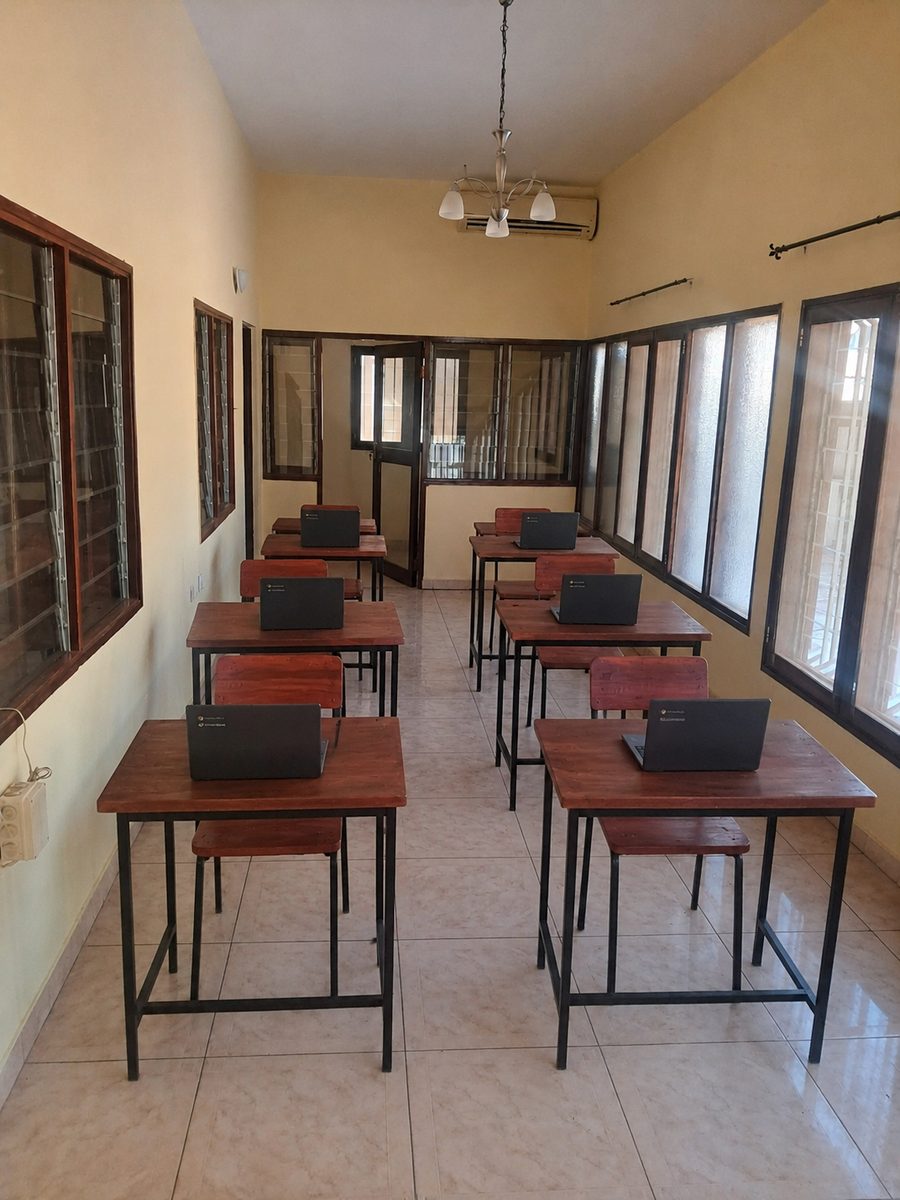
Every Starbridge academy runs the same disciplined hour: a welcome ritual, teacher-led group speaking, guided practice on Chromebooks with AI tools over high-speed Starlink internet, and a closing routine. Humans teach speaking and confidence; software drills vocabulary, listening, and typing. English from day one.
Sustainable by design
Starbridge is deliberately not donation-dependent. Academies charge fair local tuition, pay local salaries, and are expected to reach break-even as businesses. Philanthropy accelerates new academies; it doesn’t keep the lights on.
Why English, here
Starbridge doesn’t teach English because English is prestigious. It teaches English because of where our academies are. A Portuguese-speaking country surrounded by English-speaking ones creates constant demand at the border: trade, transport, services, and the international operations that follow them. The same logic will pick our next cities. We open where a second language is the difference between local work and regional work.
What it takes to open an academy
Founders are selected on English, teaching or leadership experience, and commitment to run a school every day. Gender is not a criterion.
Who
A returned missionary living in the community where the academy will open, with the English to teach in it and the intent to build something permanent there.
What a launch requires
A location, Chromebooks, satellite internet, and first-year operating runway. We don’t expect a founder to arrive with that. Assembling it is a shared problem, and it’s the specific thing our partners fund.
Timeline
Academies are designed to reach operational break-even within 6–12 months and to run without subsidy after the startup phase. That’s a target, not a guarantee — the Tete pilot is validating it now.
Commitment
An initial 12–24 month license, weekly operating reports, monthly financials, and quarterly strategic reviews with the Foundation.
Non-negotiables
Transparent books, no commingling of academy and personal funds, the Starbridge classroom model, and our student-protection standards.
If that reads as demanding, it should. We’re building a network meant to outlast us.