PILOT ACADEMY — NOW OPEN
Tete, Mozambique
Our first academy — and the proving ground for everything Starbridge does. Classes began in October 2026.

Why Tete
Tete sits on the Zambezi River in northwest Mozambique — a provincial capital of over 300,000 people with real economic activity, ambitious young people, and almost no affordable options for practical English or digital training. Portuguese is the language of daily life; English is the language of opportunity. That’s exactly the gap Starbridge was built for.
Mozambique is Portuguese-speaking, and every country on its border — Tanzania, Malawi, Zambia, Zimbabwe, South Africa, and Eswatini — uses English as an official language. Mozambique joined the Commonwealth in 1995. In Tete province, an internationally operated coal industry brings companies, contractors, and suppliers that work across those borders. English here isn’t preparation for somewhere else. It’s access to the economy already at the door.
In the classroom


The first cohorts started on October 7, 2026, in morning, afternoon and evening sessions, six days a week. Classes are small and taught in person; the platform carries the drilling and speaking practice between lessons. The academy posts in Portuguese for Tete families on its Facebook page — follow it to see the classroom as it is, not as we describe it.
What students get
Practical English for work, from absolute beginner
Digital literacy: computers, email, documents, internet
AI practice tools, always guided by real teachers
Small classes with mandatory attendance
Chromebooks and Starlink internet on site
A Starbridge certificate of completion

Run locally
Victor Manuel José Rebo founded Starbridge Learning Academy in Tete, Mozambique.
He learned English on a two-year mission in the Zimbabwe Harare Mission, and he has been teaching ever since. Today he serves as an in-field mentor for The Church of Jesus Christ of Latter-day Saints, training full-time missionaries in teaching, planning, and goal setting, and as a volunteer service missionary with BYU-Pathway Worldwide, supporting students pursuing higher education. He is a BYU-Pathway student himself, currently studying digital marketing.
Outside the academy he reads, watches documentaries, and spends time at the gym.
The Foundation provides the curriculum, technology standards, and support — the academy’s success belongs to Tete.
The pilot’s job
The Tete pilot exists to prove three things: that students make real progress, that a locally owned academy can sustain itself on fair tuition, and that the model is ready to replicate in the next city. We’ll share what we learn — including what doesn’t work.
Common questions
These are the questions we get asked most, including the ones we find hardest to answer.
If English opens doors, why hasn’t our founder walked through one?
It’s the right question, and the answer is why the Foundation exists.
Start with what’s true. English does open doors in Tete. This province borders Zambia, Malawi, and Zimbabwe, and the businesses that work across those borders run on it — freight and logistics, mining services and the suppliers around them, hospitality, NGOs, administration. A student who finishes here is a stronger candidate in this city, not only in the capital.
What English can’t do on its own is prove that you have it. A returned missionary comes home fluent and holds no certificate, no test score, and nothing an employer can check, and employers hire what they can verify. That is the difference between our founder’s position and his students’. They finish with instruction and a certificate in hand. He came home with neither.
The other half of the answer is that a job was never the best use of what he brought home. English is scarce here — scarce enough that the highest return on it is not applying for the work that requires it, but teaching it to the many people who want it and have had nowhere affordable to go. That isn’t a weakness in the case for English. It’s the strongest evidence for it.
Victor didn’t fail to find a door. He built one, and the academy is now the market between the skill he has and the neighbors who want it.
Then why teach English instead of a trade?
Because of where Tete is. Mozambique is Portuguese-speaking, and every country on its border — Tanzania, Malawi, Zambia, Zimbabwe, South Africa, and Eswatini — uses English as an official language. Mozambique joined the Commonwealth in 1995. Tete province hosts an internationally operated coal industry, which brings companies, contractors, and suppliers that work across those borders. English here isn’t preparation for somewhere else; it’s access to the economy already at the door. It also compounds rather than competing: a welder who speaks English is a more valuable welder. And practically, a trade school needs workshops, tools, and consumables. An academy needs a room, a teacher, devices, and a connection — which is why this model can be handed to the next founder in the next city.
Isn’t the real problem jobs, not skills?
Partly, yes, and that is exactly why the model puts a business at the center instead of a training program. We are not only trying to make graduates more employable in a market that may not have room for them. Each academy is work created: a founder who runs and owns the company, and teachers hired as it grows. The first job this model produces belongs to the founder.
Can a returned missionary actually teach English well?
Founders teach beginners, and for beginners an adult who learned English as a second language is an advantage rather than a compromise. A founder has made every mistake the students are about to make, in their own first language, and can explain the way out in Portuguese when a student is stuck. What founders don’t have to invent is the course or the AI learning tools: the Foundation writes and sequences the curriculum level by level, and the Starbridge Learning Platform carries drilling, listening, reading, and speaking practice between classes. The founder is the teacher, not the entire method.
What happens if the founder walks away, or simply can’t make it work?
This is the largest single risk in the pilot and we don’t have a way to eliminate it. One person’s motivation carries a one-person business. It is a large part of why the pilot is one academy rather than ten. What we can do, we do: the Foundation selects founders deliberately, trains them through launch, and stays involved afterward rather than handing over a manual and leaving. The curriculum, the platform, and the brand belong to the Foundation, so if a founder steps away, the next one inherits a working academy instead of starting from nothing.
Will families in Tete actually pay for this?
That is the question the pilot exists to answer, and it will be answered with enrollment rather than projections. Tuition is set locally, in local currency, by the founder who knows what local families can pay, and it is published on the academy’s own site. We would much rather learn that the price is wrong in one city than discover it in ten.
Why should philanthropy fund a business the founder gets to own?
Because the barrier isn’t the business — it’s the first month. A young founder in Tete can run an academy and cannot personally finance a room, devices, a connection, and the months before enrollment covers costs. The Foundation lends that startup capital: a loan, not a stake. Founders keep the profit, and the Foundation takes no equity and no royalty. Because the loan is repaid out of operations once the academy is running, the same philanthropic dollar can open a second academy after the first.
What happens if a loan isn’t repaid?
The loan is repaid from academy operations on terms designed to be sustainable, and we work with founders through slow periods rather than against them. If an academy ultimately fails, the Foundation absorbs the loss — the risk sits with us, never with the founder’s family. We publish what we learn either way.
Why not just give students a free app?
Free apps already exist, in Tete as everywhere else, and they are not what’s missing. What’s scarce is a room with a scheduled class, a teacher who notices when a student is lost, other students to actually speak with, and a device and connection the student doesn’t have at home. Speaking a language is a social skill, and almost nobody finishes a course alone on a phone. The academy provides the part that is hard to provide. The platform provides the practice in between.
Why one academy first instead of several?
Because a pilot that can’t fail proves nothing. The three things this one is meant to establish — real student progress, an academy that sustains itself on fair tuition, and a model ready to hand to the next founder — can each turn out false, and we would rather find that out at the cost of one academy. Opening several at once would spend more and teach us less.
How will you know whether it worked — and how will we?
We track what can be checked: enrollment, how many students stay through a full course, how many complete each level, how many certificates are issued, and whether the academy covers its own costs without help. We report what we find, including the parts that don’t work. We make no placement promises — we make capable candidates.
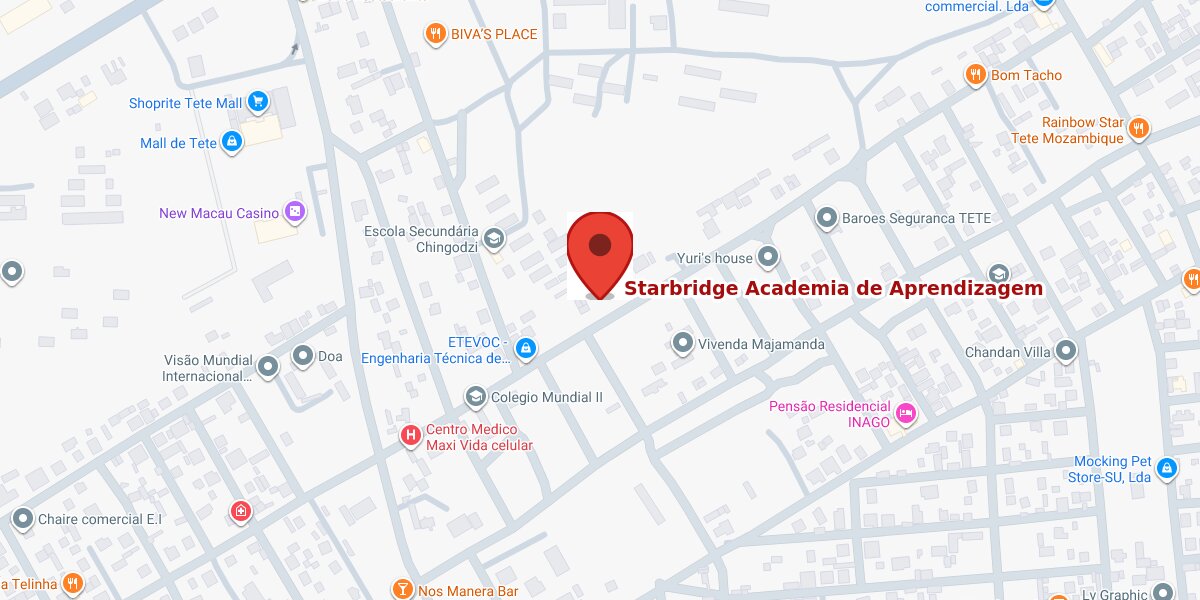
Where to find the academy
Bairro Chingodzi, Avenida 25 de Setembro, Tete 2305, Mozambique
Behind Escola Chingodzi, near Maxi Vida, in Matema.
Monday to Saturday, 08:00–20:00.

Know someone in Tete?
Classes are enrolling now.